Current affairs itna padha, par GS 2 ka answer likhne baitho toh kuch nikalta hi nahi
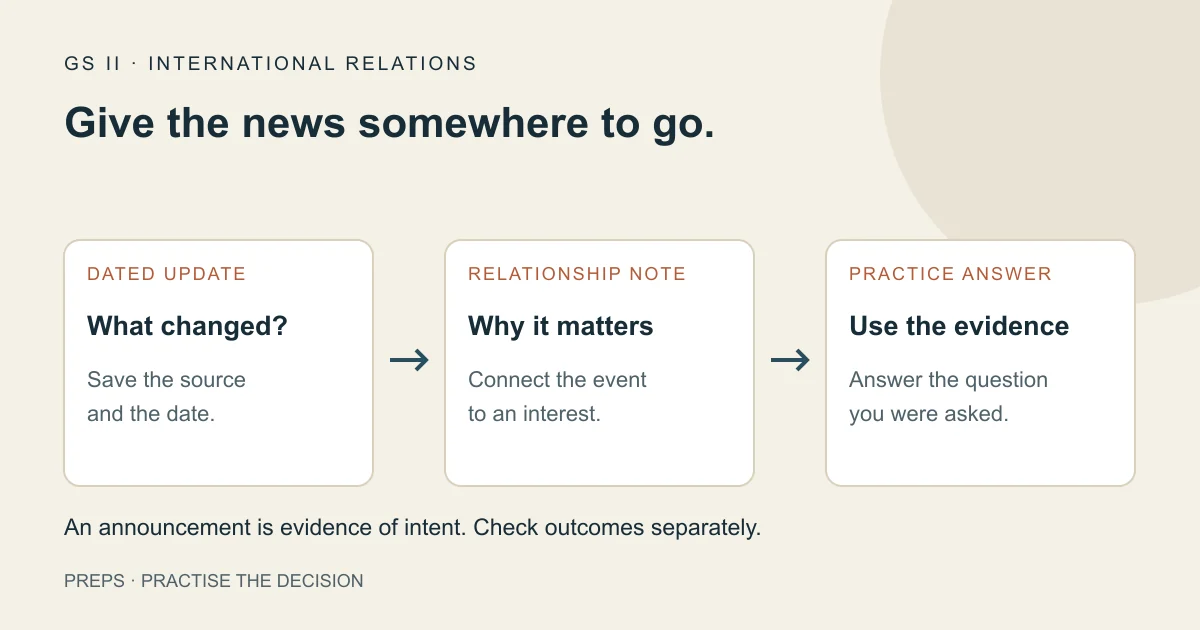
You've read about another summit. There are agreements, a joint statement and a photograph of two leaders shaking hands. You save the update. Then the next summit arrives.
After a month, your International Relations folder can tell you who visited whom. Ask why a relationship matters to India, though, and the answer still feels scattered.
I'd give the news a home before collecting more of it. For UPSC GS II, that means a small set of relationships, institutions and issues you understand well enough to explain. Current affairs can then change or illustrate that understanding. They don't have to arrive as another disconnected page.
Start with what you need to explain
The IR portion of the 2026 CSE syllabus covers India's neighbourhood relations; bilateral, regional and global groupings and agreements affecting Indian interests; the effects of other countries' policies and politics, including the diaspora; and international institutions, agencies and fora. Use those tasks to bound your preparation.
This article focuses on GS II preparation, not the full Political Science and International Relations optional. An interesting geopolitical lecture may help you, but you don't have to adopt an optional-sized course whenever a newspaper uses an unfamiliar term.
Take one relationship from your current reading. Before choosing another book, try answering:
- What does India seek through this relationship?
- Where do the two countries cooperate, and through which arrangements?
- What limits that cooperation or makes it difficult to deliver?
- What has changed, and why might that change matter?
If you can't explain the first two, you need some foundation. If you can explain them but your latest example is old, you need an update. “Static or current affairs?” becomes easier when you name the missing work.
Build one note that can survive the next summit
Choose one concise foundation source you can understand and check against the syllabus. It might be an appropriate textbook section or reliable GS material. Use it to establish the relationship's essential background, India's interests and the main areas of cooperation and disagreement.
Don't start by making an encyclopaedia of every country. Complete one relationship far enough to attempt a relevant question, then use that experience to decide how much detail the next needs. Consult actual past papers for the kinds of demands set; don't assume that a theme appearing before predicts the next paper.
For a bilateral note, I'd keep this working arrangement:
| Part of the note | What earns space |
|---|---|
| Why it matters to India | Specific interests, explained rather than labelled “strategic” |
| Essential background | Events or arrangements needed to understand those interests |
| Cooperation | A few distinct areas with accurate supporting examples |
| Limits and choices | A sourced constraint, competing interest or implementation problem |
| Dated updates | Changes that strengthen, qualify or replace an existing point |
| A question to answer | Something that makes you use the note rather than recite it |
These headings are storage prompts. They aren't six compulsory subheadings for every exam answer. The question decides which material you use.
Watch one update become an explanation
Use the 29 August 2025 India–Japan summit statement as a dated teaching example. It is historical material here, not a claim to summarise the relationship's latest position in October 2026.
The official statement, paragraph 4 announced an economic-security initiative. It identified supply-chain cooperation in areas including critical minerals and semiconductors, alongside other sectors. Paragraph 7 also discussed further review of the implementation of the trade agreement.
A collection note might stop at:
29 August 2025: India–Japan Economic Security Initiative announced. Critical minerals; semiconductors.
That preserves the event. Now ask what it can help you explain. Here's an original analytical note, distinct from the source's wording:
Supply-chain cooperation gives the economic relationship a security dimension: disruption to an essential input can affect industrial production. The 2025 initiative provides a dated example of the two countries seeking cooperation on this problem. Its practical value would depend on projects and firms turning the announced intention into dependable supply.
Notice the last sentence. It is a conditional analytical judgment, not a finding that the initiative succeeded or failed. To claim actual diversification, you would need implementation evidence. A joint statement records commitments and official positions; it doesn't, by itself, measure their results.
You can now file the update under economic cooperation and use it to explain an interest. The summit's ceremonial details don't need equal space in that note.
Let the question change what you retrieve
Try this original practice question, not a UPSC PYQ:
How can cooperation on critical supply chains deepen an economic partnership? Explain one limitation to treating an announcement as evidence of success, using the dated India–Japan example above.
A relevant plan would identify why dependable inputs matter, connect that concern to the announced cooperation and explain what evidence is still missing. You could then write a short answer from the checked material.
A weak answer would list every area of India–Japan relations you remember. Culture and defence might matter to a different question. Here, they would crowd out the requested explanation.
Change the task to “What evidence would you seek to assess implementation?” and the note should produce a different response: identified projects, delivery milestones or demonstrated changes in supply, with appropriate sources and dates. Don't invent those findings because your framework has an empty box.
That is the point of combining foundation and news. The foundation helps you explain a relationship; the update supplies a dated example; the question determines the selection. If turning the plan into prose is difficult, the worked answer revision shows how to examine what each sentence contributes.
You can leave some news out
Keep an update when it changes your understanding, supplies useful evidence, clarifies an agreement or illustrates an institutional role. If it repeats a familiar position without adding something you need, read it for context and move on. You don't owe every official visit a separate revision sheet.
When you save a fact, keep its date and source beside it. Distinguish a proposal, signed agreement, target and completed outcome. A target from an old summit should not quietly turn into a current achievement after three rounds of revision.
For an unfamiliar institution, check its mandate, membership and relevant decision-making arrangements from its own official material. For a disputed issue, a government's account establishes that government's position; use other appropriate sources before treating contested claims as settled facts. For trade figures, retain the period, unit and source. You can omit a number you cannot verify without losing the ability to explain the underlying interest.
The newspaper-selection article helps with the broader daily reading decision. Your IR note has a narrower job: preserve what you can use to explain the issue again.
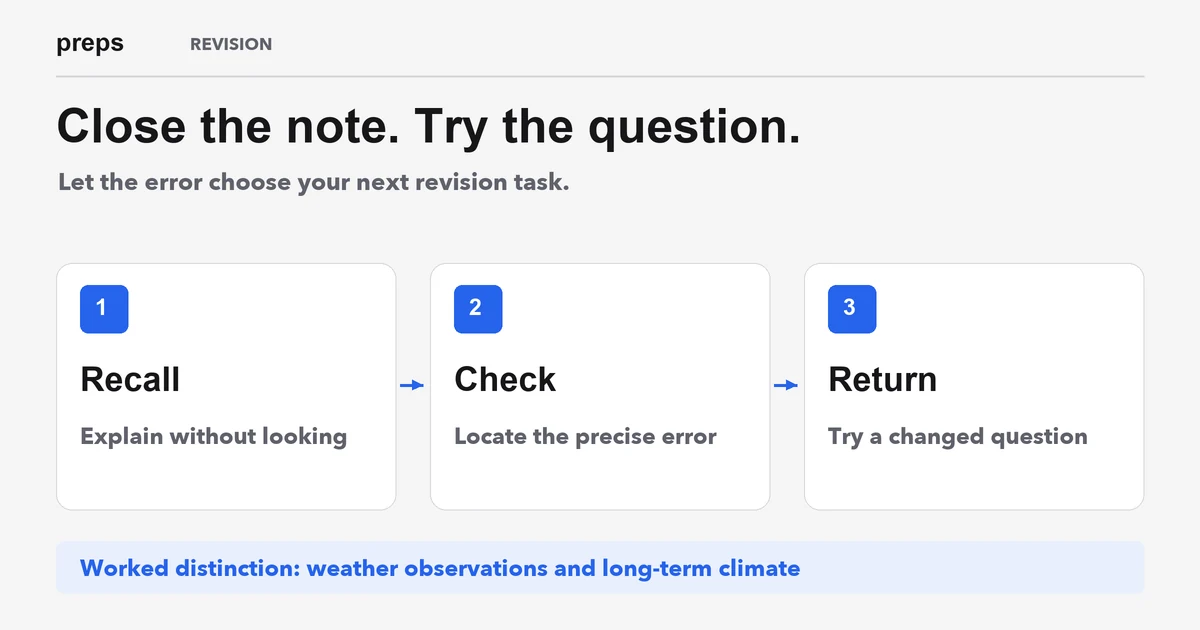
Close the folder and see what remains connected
After studying one relationship, put the material away. Explain why it matters to India, support one point with a dated example and identify one limitation on your claim. Then reopen the source and check what you got wrong or left vague.
If all you remember is the summit date, practise the connection between the event and the interest. If you remember a polished argument but can't support its factual claim, return to the source. If the note is accurate but takes too long to retrieve, reduce duplicated material and test it again.
You don't have to finish “all static IR” before opening the newspaper. Nor does reading every update guarantee a foundation. Start with the relationship that confused you today, learn enough background to explain the new development, and put that development into a note you can actually use. Tomorrow's news will have somewhere to land.