UPSC ka language paper “sirf qualifying” hai. Isi bharose par chhod doge?
GS ke notes ready hain. Optional ka test bhi de diya. Ask when you last wrote a précis or translated a passage into your chosen Indian language, though, and the answer becomes “school mein kiya tha”.
“Sirf qualifying” describes how a paper contributes to the examination. It doesn't tell you whether you can complete its tasks today.
I'd find that out before the rest of Mains preparation starts competing for every available hour. You may need a modest amount of targeted practice. You may need help with a skill you haven't used for years. A conversation in the language won't tell you which.
First, be precise about what is at stake
Under the 2026 UPSC Civil Services notice, pages 26–27, Paper A is the qualifying Indian-language paper and Paper B is English. Each carries 300 marks. The notice specifies a minimum of 25% in each applicable qualifying language paper; their marks do not count towards ranking.
The notice says the merit papers and qualifying papers are evaluated simultaneously, with Essay, General Studies and Optional papers taken into account only for candidates meeting the language qualifying standards. Saying “the examiner won't even evaluate your GS paper” misstates that process. The qualifying requirement is serious enough without adding an invented procedure.
Paper A has exemptions. Page 27 lists candidates hailing from Arunachal Pradesh, Manipur, Meghalaya, Mizoram, Nagaland and Sikkim. It also specifies a conditional exemption for the hearing-impairment subcategory of persons with benchmark disabilities: exemption from second- or third-language courses by the relevant Board or University, together with the required undertaking or self-declaration. Don't reduce that to “all PwBD candidates are exempt”. Check the actual conditions that apply to you.
These are 2026 rules. Consult the notification for your target examination when it is issued, including the permitted language, script and any exemption requirements. Preparation advice here is not a ruling on your eligibility for an exemption.
Test the writing you have been assuming is fine
The notice's language syllabus, page 33 covers comprehension, précis, usage and vocabulary, and short essays. Paper A also includes translation between English and the chosen Indian language. The stated standard is matriculation or equivalent.
Use the official UPSC past-paper archive to find English (Compulsory) and the compulsory paper in your selected Indian language. A literature optional paper is a different paper. Check the year and title on the downloaded document.
For an initial check, attempt a comprehension task, a précis and some usage questions from a paper. For Paper A, include translation in both directions. Follow that paper's instructions and record the time you use. Then complete a whole paper under its printed time limit on another sitting; a few successful extracts cannot establish that you can finish everything.
Keep evidence of what went wrong:
| What you observe | What I'd investigate next |
|---|---|
| You understand the passage but omit its main qualification in the précis | Selection of meaning and compression |
| You know what you want to say but repeatedly stop to recall spellings or script | Written fluency and specific language corrections |
| A translation sounds smooth but changes who must act, or turns permission into an obligation | Accuracy of meaning, checked by a competent reader |
| Individual tasks are manageable but you leave sections unfinished | Whole-paper allocation and writing pace |
Several can happen together. Don't turn this into a diagnosis from a total score alone. For essays and translations, self-marking can miss the very errors you need to find; seek feedback from someone competent in the relevant language and task. An AI score isn't an official qualifying result.
A short précis can quietly lose the entire point
Here is an original fictional practice passage. It describes no actual library or government policy:
A town library extended its evening opening hours after residents said daytime visits were difficult. Attendance increased, but the librarian cautioned against treating the increase as proof that the change had helped everyone. Some residents still lacked transport after work. Others did not know about the new hours. The library therefore proposed informing neighbourhood groups and asking visitors how they travelled. It would review both attendance and the difficulties reported before deciding whether to keep the extension. The librarian also noted that examination season might have contributed to the increase. Comparing a busy examination month with a quiet holiday month would not, by itself, reveal the effect of longer opening hours. The review would need to account for that difference.
For this exercise, aim for 40 words. That is one-third of this 120-word passage. In an actual paper, use its stated instructions, length and counting conventions.
A tempting but faulty précis is:
Longer opening hours helped all residents use the library. Attendance proved the extension successful, so the librarian decided to retain it and provide transport.
It is short. It also invents universal benefit, a final decision and a transport service. The passage says none of those things.
Here is a 40-word model précis for this exercise:
Evening attendance rose after a library extended its hours, but transport barriers, limited awareness and examination season complicated assessment. Before retaining the extension, it proposed outreach and travel enquiries, assessing attendance alongside reported difficulties while allowing for differences between seasons.
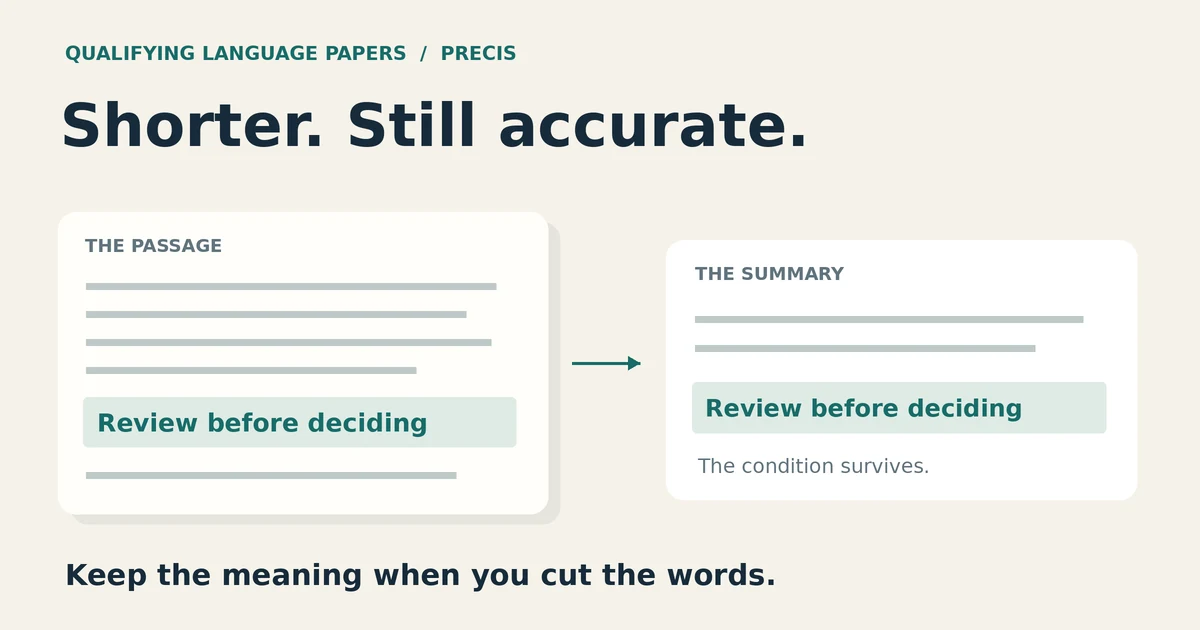
I'd check the summary against the source sentence by sentence. It retains the increase, the unresolved barriers, the proposed response, the conditional decision and the seasonal qualification. It changes the wording while preserving the argument. A précis can fail by becoming inaccurate long before it becomes too long.
Try your own version before copying this one. Explain what each sentence preserves and what you removed. Then use a longer passage under the instructions of the past paper you selected. This small example teaches a check; it isn't a complete simulation or a prediction of marks.
Translation needs someone to check the meaning you changed
Speaking comfortably can conceal gaps in formal writing. For a useful translation exercise, choose a short passage with a clear instruction, condition or exception. Translate it without a model open beside you, then compare against an appropriate published translation or seek feedback from a competent reader.
Ask specific questions: did “may apply” become “must apply”? Did a proposed action become a completed action? Does a condition apply to the same group in both versions? Has your sentence preserved a negation?
Where a government source provides both language versions, it can supply comparison material. Check that the versions refer to the same release and date. Public prose is practice material, not an official marking key; a published version need not be the only acceptable translation.
Don't take a smooth machine translation as proof of accuracy. If you cannot explain a correction, ask what meaning or grammatical relationship it repairs. Practise that point in a fresh sentence. The aim is writing you can reproduce accurately, including in the script required for your selected paper.
Put practice where the evidence says you need it
If comprehension is comfortable but précis work drops qualifications, give your next session to selecting and retaining meaning. Check a new summary against its passage. If script or grammar repeatedly blocks you, seek targeted instruction and practise short corrections before expecting a full essay to become fluent.
For a short essay, plan a position, reasons that support it and an example you can explain. Write the piece, then ask whether each paragraph advances the topic. Elegant language cannot rescue an answer that has drifted away from it. Follow the actual paper's word and time instructions rather than importing a GS-answer template.
Once individual tasks improve, return to a whole paper. Record unfinished sections, rushed work and errors that return under the clock. Use those observations to decide what your next week needs. Someone with a sound baseline can maintain practice; someone whose writing has become rusty may need regular supported sessions. Neither needs a universal “seven days is enough” promise.
For a working aspirant, reserve a session in which you can write and review something, rather than filling every spare ten minutes with more language videos. The working-week article discusses planning around the time you actually have.
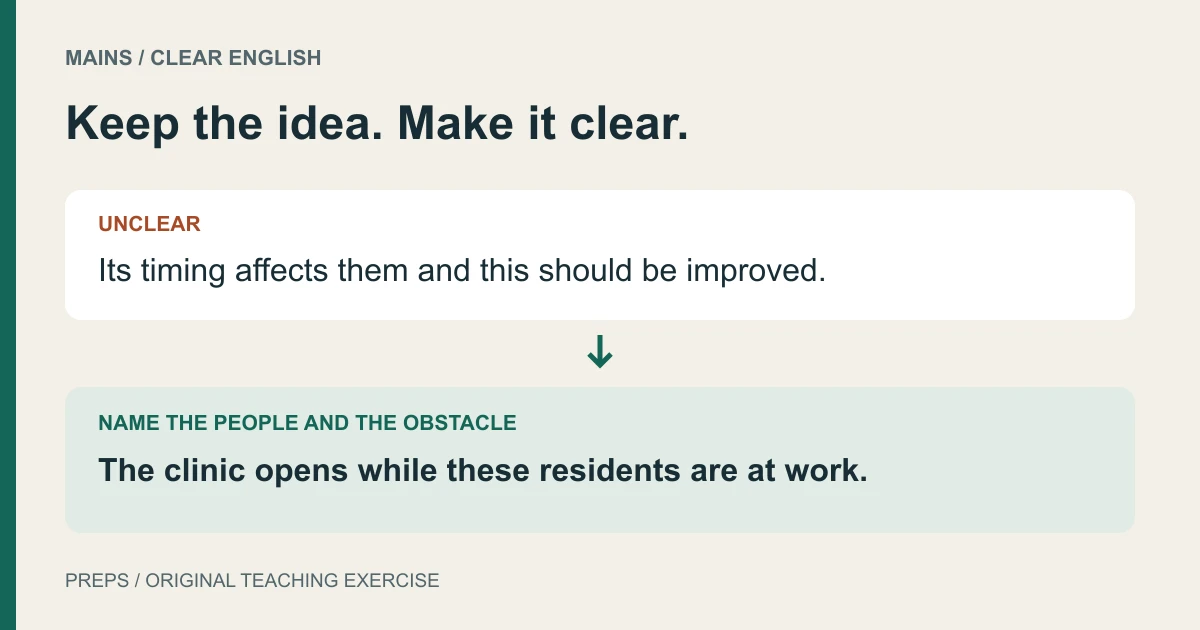
Keep this separate from English-medium GS expression. The clear-English article works on communicating a subject answer; it doesn't cover all the tasks of qualifying English, choose your Mains medium, or replace Paper A preparation.
Find the correct compulsory paper and write one task today. Keep the uncorrected attempt. When you return to it, you should be able to point to what improved, what still needs help and what you have yet to test in a full paper. “School mein kiya tha” can then retire from its job as your preparation strategy.